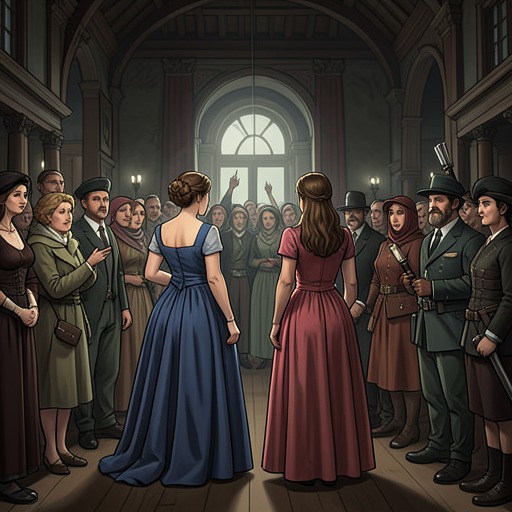
Seymour Grimes
Poor ThingsSeymour Grimes is the London detective whose reconstruction of Bella Baxter’s disappearance turns scattered dates, records, and a witness’s account into the central evidence at a private inquiry. His findings trace Bella from her disappearance in London to her recovery from the River Clyde and eventual reappearance in Glasgow, but leave unresolved the crucial question of how the woman presumed dead could be present again. Grimes is practical and precise about the limits of what he knows: he can establish the chain of recorded events, but not explain its missing link.
Identity and Introduction
Grimes is introduced at the private discussion arranged by General Sir Aubrey de la Pole Blessington at St Enoch’s Station Hotel. The General’s solicitor presents him as a representative of the Seymour Grimes Private Detective Agency, and Grimes rises when his agency is named. The meeting itself is carefully restricted: the General has permitted a discussion between his own party and Godwin Baxter and Archibald McCandless, while Bella is required to wait in an adjoining room. Her protest at being excluded makes the stakes plain. Grimes has been hired to investigate her disappearance, but the inquiry is being conducted without her participation.
McCandless describes Grimes as an ordinary-looking man of about thirty, with no immediately distinctive feature except his rapid London manner of speech. In the account, his clipped delivery drops first-person pronouns. That verbal economy suits the work he presents: dates, records, and observations arrive in quick sequence, with little embellishment. The apparent plainness of his manner also contrasts with the extraordinary conclusion his evidence approaches, without itself supplying an explanation for it.
The Disappearance Investigation
Grimes says he was called in seven days before the meeting, three years after Bella vanished. He had been given a photograph and traced the inquiry to Glasgow, where Duncan Wedderburn was confined in a locked ward of Glasgow Royal Lunatic Asylum. Wedderburn’s letter had directed attention there, though the General’s lawyer dismisses the letter as too extravagant to be trusted. Grimes nevertheless treats it as a lead and tests it against other evidence.
He searches police and Glasgow Humane Society records for women who might match the missing woman. The records bring him to a report that a woman resembling Bella had been seen diving from a bridge into the Clyde on February 8, two days after her disappearance from 49 Porchester Terrace on February 6, 1880. George Geddes, an employee of the Humane Society, had recovered her from the river. The woman’s body was unclaimed and, according to the record Grimes follows, was taken to University Medical College on February 15.
Grimes then compares that account with the College’s ledgers and with the dates surrounding Godwin Baxter’s departure from police work. The ledgers record no corpse delivered there by Baxter on February 15 or afterward. On February 16, Baxter wrote that he was resigning from police work to concentrate on private practice. Grimes adds circumstantial signs of Bella’s presence at Baxter’s house: by the end of February, local tradesmen delivering to 18 Park Circus knew Baxter had a female patient living there, initially paralysed; by April she could walk, though she remained childish. Three years after the disappearance, she is sitting at the inquiry, apparently recovered and preparing to marry again.
The Missing Link
Grimes’s reconstruction is powerful because its evidence does not resolve the mystery it uncovers. His sequence connects a missing woman, a body recovered from the Clyde, a mortuary record, Baxter’s change of employment, and a female patient whose condition changes over time. Yet it also creates a direct contradiction: if the recovered body lay in a mortuary for seven days, how can the woman presumed dead be present at the meeting?
Baxter identifies that gap explicitly, invoking Geddes’s reputation and asking how the corpse he recovered can be reconciled with Bella’s presence. Grimes does not claim knowledge beyond his investigation. He shrugs and says that the question is not his department. The answer marks both a limit and a strength in his role: he has assembled evidence that makes the official sequence untenable, but does not pretend to possess a solution that the records cannot provide. The detective’s findings therefore reveal the problem rather than explain it.
Conduct at the Confrontation
Grimes remains present as the inquiry turns from private questioning to physical danger. When the General takes a revolver and threatens Baxter while Grimes is directed to keep McCandless seated, Grimes speaks to McCandless politely. After Bella steps between Baxter and the General, grips the gun barrel, and turns it down, Grimes announces that the game is up. He then locks the safety catch of his own revolver and pockets it, accompanying the action with an apologetic shrug toward McCandless.
The General refuses to accept that the confrontation has ended. Grimes’s declaration is thus an assessment of the immediate balance of power, not a final resolution: Bella has taken control of the weapon, but the General is still able to rise and direct it toward himself. Grimes’s restrained response differs from the General’s calculated threats. He neither expands his investigative authority into control of Bella nor claims to determine what happens next; his visible action is to make his revolver safe and withdraw it.
Narrative Role
Grimes functions as an investigator and as a boundary-marker for the inquiry. He supplies a chronological chain strong enough to bring Bella’s disappearance and apparent death into the room, but his candour about the missing link prevents that chain from becoming a falsely complete explanation. The contrast between his methodical record-checking and the impossible-looking result gives his testimony particular force: the mystery is sharpened by ordinary evidence, not dispelled by it.
His presence also changes the discussion from competing assertions into a testable account. Wedderburn’s letter may be dismissed as delirious, but Grimes has independently checked its lead against institutional records and a witness’s report. At the same time, the meeting’s exclusion of Bella underscores the limits of treating her as an object of investigation. Her intervention with the revolver interrupts a proceeding arranged to discuss her without her, while Grimes’s evidence remains important but incomplete. He is therefore neither the solver of Bella’s history nor merely a messenger: he establishes what can be known, exposes what cannot yet be reconciled, and leaves the decisive contradiction in view.